A First Visit to an In-the-Round Show
A first visit to an in-the-round show feels easier when you choose a seat for clear sightlines, then let attention move with the action.
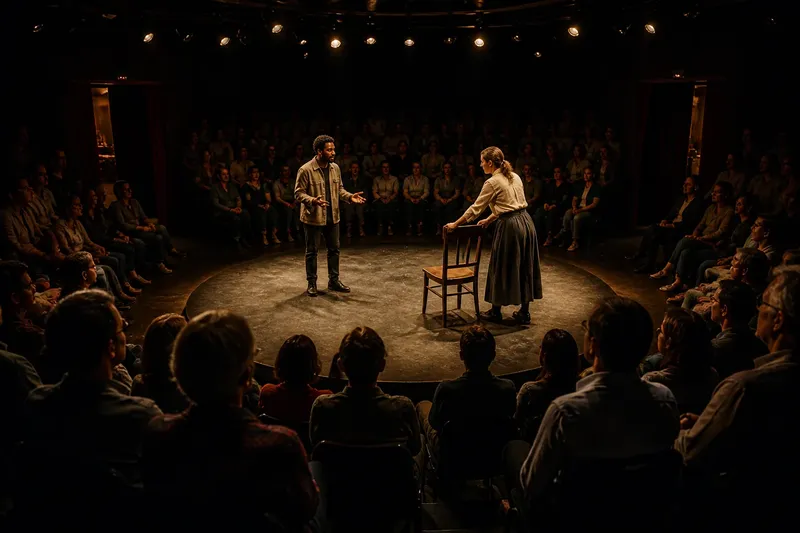
At an in-the-round show, a character may speak from behind you while another crosses the space in front, and your seat determines which moments you see clearly. For a first visit to an in-the-round show, you do not need to watch every side at once; a calm choice of seat and a flexible way of listening are enough to settle in.
In-the-round staging places the audience around a central playing area rather than in front of a single stage. Performers may turn towards different sections, and a scene can shift direction without a set change. The practical question is not how to claim the perfect view, but how to choose a workable angle and allow your attention to travel.
Check the room before choosing a seat
When booking, look for a seating plan that shows the playing area, aisles, entrances and any raised or stepped rows. Some productions use a square or circular arrangement; others place seats around a central platform with gaps for performers to enter. These details matter because a clear view depends on where action can happen, not simply on how near you are.
If you can select a seat, begin by checking whether the rows are tiered. A raised row can help you see over people in front, while a seat at floor level may feel closer but leave parts of the action blocked when someone stands. A central seat is not automatically best: in a compact room, the outer edge may give you a better view of movement across the space.
Also check the venue’s access information and contact the box office if you need a particular sightline, step-free route, companion seat or space for a mobility aid. A seating diagram cannot show every practical detail. Staff can explain the room’s layout and what options are available.
Choose a seat for the view you value
In-the-round seating involves a trade-off. Sitting close can make facial expression and small gestures easier to read, but you may have to turn more often or look upwards. Sitting farther back can help you take in the whole playing area and notice how performers arrange themselves around it, though subtle expressions may be less distinct.
Think about what usually helps you follow a performance. If you like seeing expressions and listening to individual voices, choose a place where you can see faces without a steep upward angle. If you prefer to follow movement and the shape of a scene, favour a view of the full playing area. Where possible, avoid choosing solely by proximity: the nearest seat can place you beside a performer’s back for part of a scene.
Consider how much turning feels comfortable. A seat near a corner or aisle might make it easier to shift your gaze without twisting sharply. If you have neck, balance or vision concerns, ask the venue about sightlines before booking rather than assuming that a particular section will suit you. For access needs, the box office is the best place to discuss suitable arrangements.
Think of your attention like a torch rather than a floodlight: it can illuminate one part of the room at a time. You are not expected to track every performer at every second. A useful seat gives you a reliable place to return your gaze when the scene becomes busy.
Arrive with time to read the space
Arriving without a rush gives you a chance to find the entrance, locate your seat and notice the arrangement before the performance begins. Check your ticket for the entrance or seating section, and ask an usher if the row or seat numbers are not obvious. In a close-up room, quietly moving through the audience can be difficult once everyone has settled.
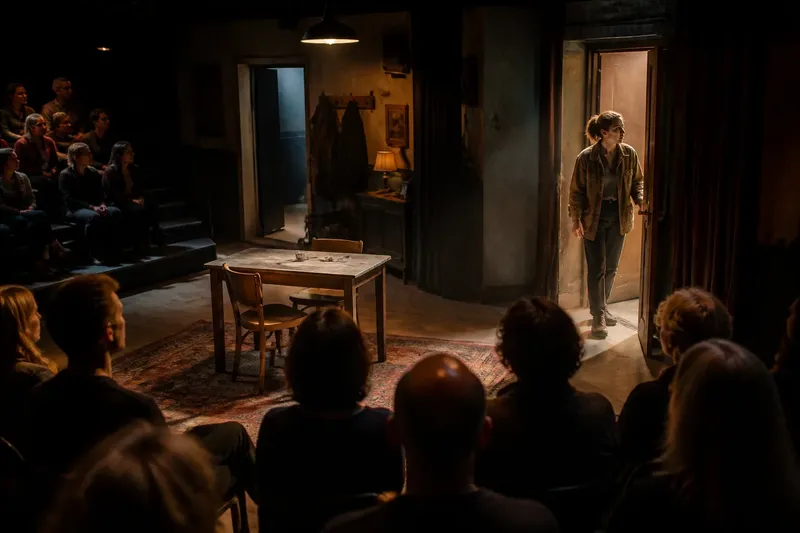
Once seated, take a moment to notice the playing area’s boundaries. Look for gaps between sections, curtains or doors that may serve as entrances, and any object that seems to mark a place within the story. You do not have to guess what these details mean. Simply knowing where the room opens can make a sudden movement easier to follow.
Notice where other audience members are sitting, too. Their bodies may briefly block part of the view, especially if rows are level. If you cannot see the central area from your seat, speak quietly to an usher before the show starts; they can tell you whether another seat is available or explain the room’s arrangement.
Keep personal belongings tucked away and follow the venue’s guidance about phones, food and photography. In a small space, a bright screen or an item left in an aisle can draw attention away from the action or obstruct someone’s route. Follow the venue’s instructions for access, seating and audience conduct; requirements vary by room and production.
Let the performance show you where to look
When the show starts, begin with the performer who is speaking, but do not treat speech as the only signal. A person listening may react before they answer; another may prepare to move while someone else speaks. These small shifts can tell you where the scene is heading, even when the dialogue points elsewhere.
If a voice comes from behind you, listen before turning. The sound may be enough to identify who is speaking and where they are. Then make a comfortable glance rather than swivelling quickly. If the speaker keeps moving, follow them only as far as you can without losing your balance or blocking someone else.
At times, several performers may occupy different sides of the space. Choose the action that seems most important in that moment: the person speaking, the person being addressed, or the object that has just changed hands. The rest can wait. A conversation is easier to understand when you follow its relationships than when you try to scan the room continually.
Imagine you are seated near one side of a small playing area when two performers begin a conversation across it. One speaks while the other quietly moves a chair into the space between them. You might first follow the voice, then glance towards the chair as it shifts the balance of the scene; there is no need to keep checking every other section while that exchange unfolds.
How should you follow a scene from every side?
Will I miss parts of the story if I cannot see every performer?
Probably some gestures will happen outside your direct view, as they do in any seat arrangement, but dialogue, movement and other performers’ reactions can help you understand what is happening. Let your attention settle on the clearest cue instead of trying to monitor the whole room.
Should I turn whenever someone speaks behind me?
Not necessarily. Listen first, then turn only if seeing the speaker would help you follow the moment. A small, unhurried glance is usually more comfortable than repeatedly rotating to check every sound.
Is a seat close to the playing area always better?
No. A close seat can reveal expression and detail, but the angle may make it harder to take in the whole space or see a performer on the far side. Choose for the view and comfort you want, rather than distance alone.
What if someone blocks my view after the show begins?
Give yourself a moment to see whether the action shifts to a clearer position. If you still cannot follow the performance, speak to an usher at a suitable interval rather than moving through the audience during a scene.
Settle back into the room after an interruption
A missed line, a blocked sightline or a moment of distraction does not require you to reconstruct everything. Listen for the next clear exchange, notice who is addressing whom, and let the scene re-establish itself. In live performance, a pause or change of position often offers a natural point to rejoin.
If you need to leave your seat, follow the usher’s directions and wait for a suitable moment where possible. The routes used by performers may cross the audience, and a doorway or aisle can be part of the staging. For anything urgent, ask a member of staff to help rather than trying to guess which way is clear.
After the performance, you may remember one side of the room more vividly than another. That is not a failure to watch properly; it is part of seeing a shared event from one particular place. For your next in-the-round show, keep track of what suited you—height, distance, turning room or access to an aisle—and use that observation to make a more informed seat choice.
The useful aim is not a view without gaps but a comfortable way back into the story whenever your attention moves. A clear starting point, a patient glance and attentive listening can make an unfamiliar room feel much easier to read.