The Gesture That Reads from the Back Row
A gesture that reads from the back row makes intention legible without extra dialogue, helping a small performance carry its turning point across the room.
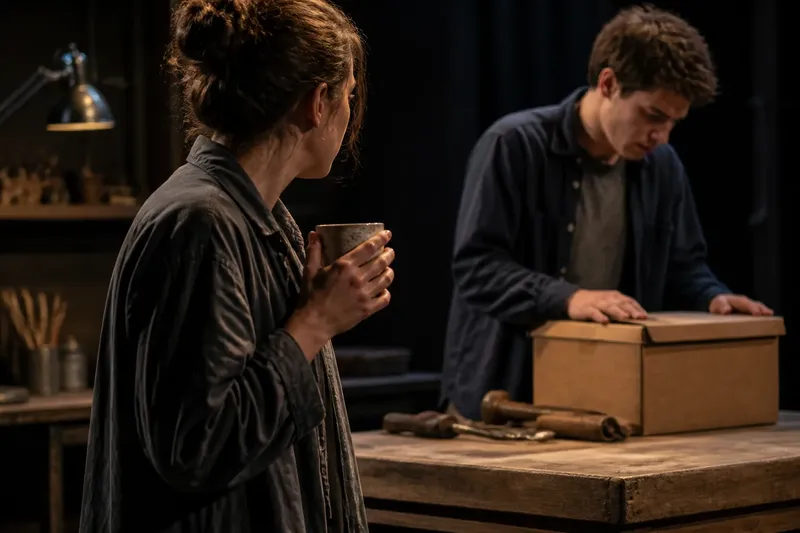
From the back row, a hand closes around a paper cup, then stops. That small change can tell you more than an added line if the gesture has a clear beginning, direction and consequence. A gesture that reads from the back row is not simply a large movement; it is an action whose intention survives distance.
Consider a small, invented studio show about two siblings clearing their late father’s workbench. One sibling wants to keep a battered cup; the other is packing the tools. The scene has little scenery and no need for a speech explaining the disagreement. Its central question is physical: will the cup be put in the box or kept out?
The action needs a readable intention
Before shaping the movement, the performer identifies what they are trying to do. In this scene, the sibling holding the cup is not merely lifting it. They are deciding whether to surrender it, and trying not to let the other sibling see that decision happen.
That intention gives the movement a line of thought: reach towards the box, hesitate, draw the cup back. If the hand simply waves about the space, the audience may notice activity without understanding its purpose. Physical clarity begins with a verb a performer can act on: offer, protect, refuse, conceal.
The chosen verb also helps remove unnecessary motion. A performer who is trying to protect the cup might turn it towards their body or place a steadying hand over its rim. A performer who is trying to offer it might extend it towards the other person and wait. These are different choices, even if both use the same object.
The room changes the shape of the gesture
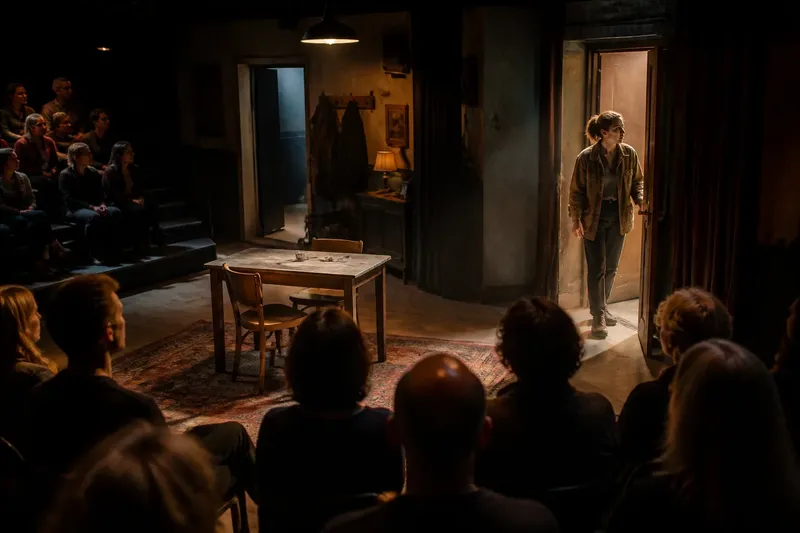
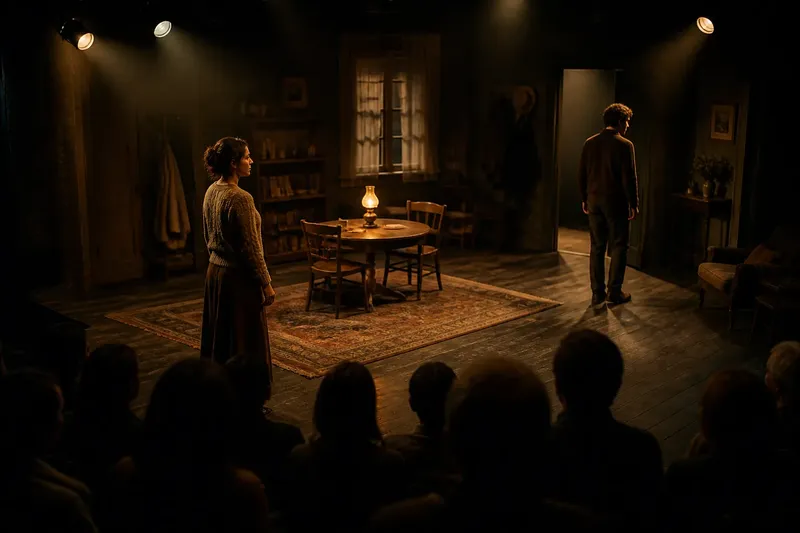
In the imagined studio, the audience sits in shallow rows, with a clear view of the workbench. The performer first tries to make the moment subtle: the cup moves only a little, close to the chest. From the front, the hesitation is legible. From the back, the cup disappears behind the performer’s forearm, and the hand’s change of direction is difficult to see.
The adjustment is not to fling the cup across the space. Instead, the performer gives the decision a more open path: the hand reaches out towards the box, pauses where the audience can see it, then turns the cup back towards the body. The action occupies a clear patch of space rather than being hidden against the torso.
Think of the gesture like a door on a hinge. The audience needs to see the door begin to swing, meet resistance and settle in a new position. If the movement starts and ends in nearly the same place, or happens behind another object, its change may vanish at a distance. A clear route through space gives the eye something to follow.
The pause makes the turning point visible
The performer adds a brief stillness at the point of hesitation. This is not a dramatic freeze held for its own sake. It is a moment in which the hand’s direction, the cup’s position and the performer’s attention all point towards the choice.
Then the sibling packing the tools closes the box lid. That sound and action prompt the cup-holder to turn the cup away. The choice becomes visible because something changes: the other character’s action arrives, the first performer responds, and the object ends in a different relationship to the box.
In the first version, the performer also glances down, shifts both feet and adjusts the cup at once. Those movements compete for attention. In the revised version, the feet remain still until the hand changes course. The audience can follow one event at a time. Stillness is useful here not as decoration, but as a clean background for the action that matters.
What should change if the gesture is still unclear?
Should a performer make every gesture larger?
No. Enlarging the movement can make it vague or mannered if its direction is unclear. First make the start, hesitation and finish easy to distinguish; then widen the path only as much as the room requires.
How can an object help an audience read intention?
An object gives the hand a visible relationship to something beyond the performer’s body. In this scene, the cup’s movement towards or away from the box supplies a concrete change, but the performer’s focus and timing still need to support that change.
Where should the audience look during a gesture?
The performer can direct attention through the focus of the eyes and the direction of the hand. If both point towards the same destination, the audience has a simple visual path to follow; if they point in opposite directions, the conflict should be deliberate and readable.
How can a small company check a gesture from different seats?
Invite a colleague to watch from the back and the sides while the performer repeats the action without adding explanatory dialogue. Ask what changed and when; if the answer centres on a different movement each time, simplify or separate the competing actions.
The result is a choice the audience can see
In this invented scene, the cup-holder finally places the cup on the workbench rather than in the box. The other sibling sees the decision, pauses, and resumes packing around it. The audience can read the outcome without a line announcing that the cup is staying. The gesture carries the story because its direction, interruption and final position make the intention observable.
The lesson is not that every important thought needs a prop or a pause. It is that movement can hold a thought in view when the performer gives it a precise aim and enough space to change. For a gesture that reads from the back row, ask what the audience should see first, what alters, and where the action leaves them. That final position is often the clearest evidence of the choice.