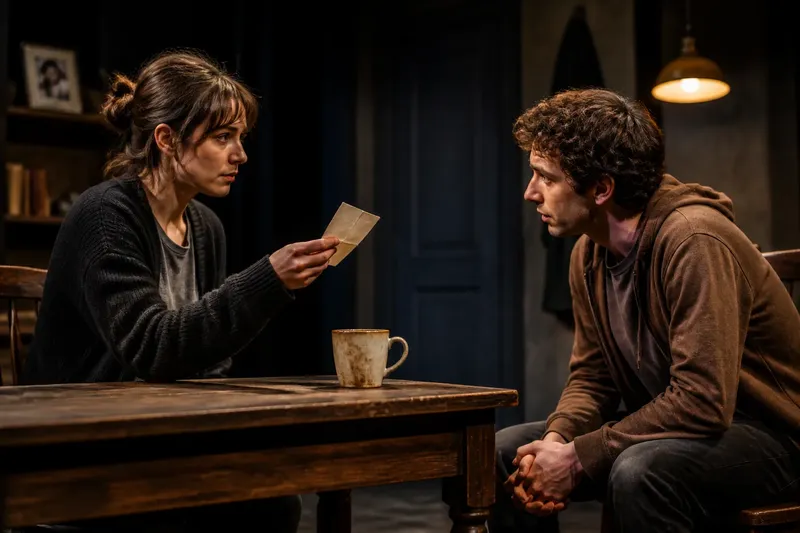
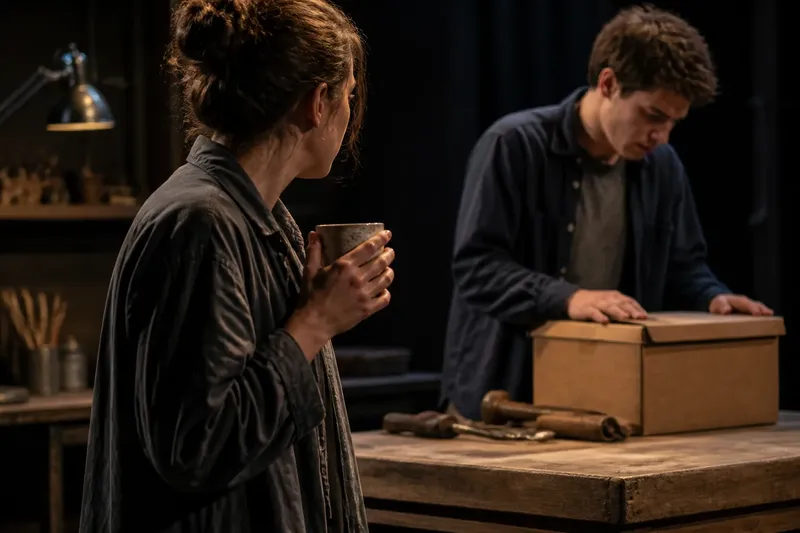
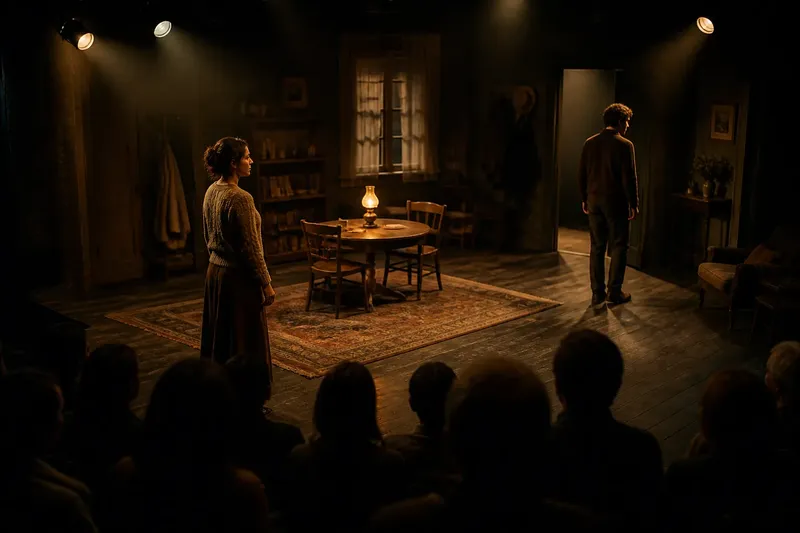
Why a Performer’s Entrance Changes the Room
A performer’s entrance changes the room before the first line: shape the route and timing to guide attention without adding explanation.
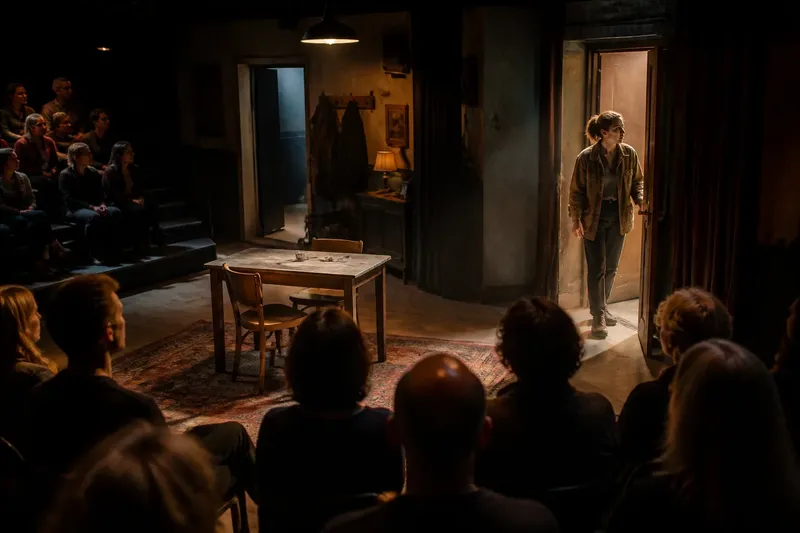
A performer’s entrance changes the room before the first line is spoken. In a small performance space, the route from an unseen threshold to the playing area can pull attention across the audience, alter the apparent distance between performer and spectator, and establish what kind of encounter is about to begin. The useful question is not simply where the performer comes on, but what the audience is already watching when they do.
The entrance begins before the performer appears
Audiences rarely arrive at the opening moment with their attention evenly spread. Someone may be settling into a chair, another may be watching a doorway, and a third may be reading the room’s arrangement. An entrance can gather these separate habits into one shared focus, but its first cue need not be the performer’s body.
A footfall behind a screen, a shift of light at a doorway, or the opening of a curtain can make the audience look towards a route before anyone enters it. The cue should belong to the performance’s world. If a visible door is used only for entrances, the audience may start watching it early; if it also serves as an ordinary room door, a performer can arrive with less ceremony.
Consider sightlines before choosing the route. A path that reads clearly from the front may disappear behind seated spectators for people at the side. Walk the route from several seats, then note where the performer’s face, hands and direction of travel become visible. The entrance does not need to be seen from every angle at once, but the audience should have a fair chance to understand where the performer has come from.
Choose a route that changes the audience’s focus
A performer entering from the rear asks spectators to turn their attention away from the playing area. That shift can make the room feel newly open: the audience is no longer looking at a framed scene but noticing the space around itself. A side entrance can be more modest, drawing attention across the room without asking everyone to turn. An entrance from within the playing area can suggest that the performer has been present all along, even if the audience did not notice.
These routes create different relationships, not a ranking from best to worst. A long cross-room passage may suit a character arriving with purpose, while a short approach from a nearby doorway can make a quiet appearance feel exposed. If the story depends on secrecy, a conspicuous procession may work against it; if it depends on a public arrival, hiding the route may soften the event.
Keep the practical route legible as well as expressive. Chairs, bags, cables and scenery can narrow a passage or turn an easy walk into a stumble risk. Rehearse with the actual layout and clear the path; do not ask an audience to make room by shifting suddenly in their seats.
Timing decides whether attention gathers or scatters
An entrance can arrive into a settled silence, interrupt an existing action, or follow a cue that gives the audience time to look towards the route. Each timing creates a different degree of readiness. A pause before the performer appears can build expectation, but if it lasts without a reason the audience may begin checking the room rather than attending to the scene.
For a measured arrival, give the audience a readable cue and let the performer enter after it has registered. For an interruption, begin the performer’s movement while attention remains elsewhere, then allow the audience to catch up. This can be achieved through contrast rather than volume: a still room followed by a steady crossing may be enough.
Imagine a performer playing a caretaker who has just heard something in an adjoining room. The audience is watching a small table at centre. A faint sound from the side doorway draws some eyes; the caretaker appears there, pauses to listen, then crosses towards the table. The route makes the unseen room part of the story, while the pause lets the audience follow the character’s attention before the first line. The observable result to look for in rehearsal is whether spectators turn towards the doorway and then track the crossing without losing the table’s importance.
Let pace and direction carry the first impression
Walking speed alone does not determine how an entrance feels. A performer moving slowly with a fixed destination can appear deliberate; a quick arrival that stops short can suggest uncertainty. Direction matters too. A direct line towards the audience can feel open or confrontational, while a curved route may seem hesitant, searching or simply shaped by the room.
Try the route without dialogue and notice what the movement invites spectators to infer. Then change one element at a time: the starting point, the first pause, the direction of the performer’s gaze, or the moment they turn towards the audience. Avoid adding several expressive signals at once. If the performer stares at the audience, rushes across the room and stops sharply, the combination may announce a meaning more loudly than the scene needs.
Small rooms also make ordinary walking unusually visible. A performer need not exaggerate each step to be understood. Often, a clear destination and an unhurried change of direction give the audience enough to follow.
Rehearse the entrance from the audience’s seats
Watching a route from the stage can make it seem clearer than it is. Ask a few people to sit in different parts of the room while the performer makes the entrance in silence. They can describe where they looked first, when they noticed the performer and whether any part of the route was blocked. This is not a verdict on whether the entrance is good; it is a way to discover what the room actually makes visible.
Pay attention to the moment just before the performer speaks. If spectators are still turning their heads, the first line may compete with the movement. A brief settling beat can help, though it need not be a full stop. The performer might reach a mark, notice something in the room, or turn towards a scene partner before speaking. The action should belong to the character, not feel like a pause inserted to wait for the audience.
Marking the route with removable tape during rehearsal can help performers repeat a crossing, especially when the room changes between sessions. Remove or replace any marking that could confuse spectators or create a hazard. The route should remain adaptable to the actual venue rather than being treated as a fixed drawing on the floor.
What should an entrance establish?
Should the audience see the performer before they enter?
That depends on whether anticipation serves the scene. A visible figure waiting beyond a doorway can create expectation, while an unseen arrival can preserve surprise. Check that the choice supports the story rather than merely making the entrance more elaborate.
How long should a performer wait before speaking?
Wait only long enough for the audience to register the arrival and for the performer’s first action to make sense. The room’s size, the route and the amount of movement all affect that moment, so judge it from the seats rather than by counting in rehearsal.
Can an entrance work without a special cue?
Yes. A performer may enter while the audience is already watching another action, then redirect attention through pace, position or a clear change of focus. A special sound or lighting shift is useful only if it adds something the movement cannot express on its own.
What if the room has only one usable doorway?
The same route can feel different when the timing, pace and destination change. A performer might arrive quietly during an existing action in one scene and cross with evident purpose in another, without needing a second entrance point.
Keep the route in service of the scene
When refining a performer’s entrance, begin with the audience’s attention: where it rests, what will draw it elsewhere, and how long it needs to follow. A doorway, an aisle or a path between chairs is not just a way into the room; it is a line the audience learns to read. Treat that line as part of the scene, then remove any cue that asks for attention without giving the story a reason to receive it.