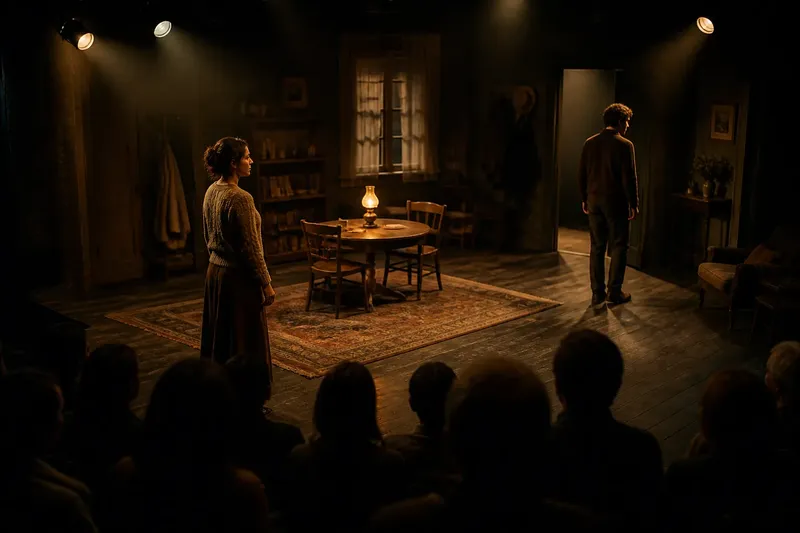
Handheld Prop or Fixed Set Piece? How Placement Shapes Expectation
Handheld prop or fixed set piece: learn how portability and placement shape what audiences expect, and choose an object that supports the story.

When a performer lifts a chipped mug from a table, the audience may wonder who last held it; when the same mug is bolted to the table, they may wonder why it cannot be moved. That difference is the practical question behind handheld prop or fixed set piece: what does an object’s relationship to the space invite people to expect?
In a small show, an object need not be elaborate to carry meaning. Its placement, handling and availability can make it feel like a tool, a boundary, a promise or a problem. The useful choice is not simply which object looks right, but what kind of attention the story needs the audience to give it.
A portable object promises the possibility of action
A handheld prop travels with a performer or can be picked up and put down during the scene. A key, folded letter, scarf or cup may change hands, disappear into a pocket, or become the focus of a brief decision. Its movement gives the audience a reason to watch what happens next.
Portability suggests choice. If a character can take an object away, offer it to someone, or refuse to touch it, those options can quietly define the relationship between them. The audience may begin anticipating the action before it occurs: the letter might be opened, the key might be handed over, or the scarf might be left behind.
That expectation is useful when the story turns on possession, exchange or reluctance. A small item can make an internal conflict visible without requiring the performer to explain it. The object does not need to carry a complicated symbolic meaning; the audience can read the simple fact that someone has it and someone else wants it.
A fixed set piece makes the space itself feel consequential
A fixed set piece belongs to a particular place. It may be attached to the floor, wall or furniture, or simply be established as something that stays put: a door that never opens, a chair that no one moves, a lamp that marks one corner. Its stillness can give the setting a rule.
Because the object remains, attention gathers around how performers relate to it. A character may avoid a chair, keep a careful distance from a doorway, or return to the same patch of floor. The audience can notice that pattern and begin to expect the place to matter, even before the story explains why.
A fixed object can also make a room feel resistant to change. A performer may leave, argue or make a decision, while the set piece remains as a quiet witness to what has happened. This is different from a portable object that can leave the scene with its holder. The fixed piece gives the story a point of reference that survives each action.
Placement tells the audience what kind of promise to watch
Think of a handheld prop as a key on a ring and a fixed set piece as the lock built into a door. The key can be carried, withheld or passed on; the lock makes the door’s place in the room unavoidable. Both can suggest access, but each creates a different question for the audience.
Placement can strengthen or blur that distinction. A cup placed in the performer’s hand reads as available for action. The same cup set carefully at the centre of a table may look reserved, ceremonial or out of reach. If the performer repeatedly approaches it without taking it, that restraint can become part of the story.
Before choosing, ask what you want people to anticipate. If you want them to watch for a transfer, reveal or refusal, a portable object gives the performer options. If you want them to feel the room’s rules, memory or boundaries, an anchored object may be more useful. The object’s meaning comes partly from what it can do in performance, not only from what it resembles.
Choose the object by the audience’s expected attention
Say you are staging a short scene about two siblings deciding what to do with a note from their absent parent. If the note is handheld, one sibling can hide it, offer it or read only part of it; the audience is likely to watch the exchange. If it is fixed beneath a clear cover on a wall, neither sibling can simply take it, and attention may shift to the room’s restriction and the reason the note has been preserved there.
Both versions could serve the same story, but they ask different questions. The portable note makes the decision personal and immediate. The fixed note makes its presence part of the setting, inviting the audience to consider who controls access and how long the message has been kept.
Try describing the audience’s likely expectation in one plain sentence before settling on a design: “They will wait to see who takes it,” or “They will wonder why it remains there.” If the sentence does not connect to a specific action or condition in the scene, the object may be drawing attention without helping the story.
Check visibility, handling and repeated use
Small-scale performance asks an object to work at close range and, often, from several viewing angles. A subtle exchange may be clear to a nearby audience member but hard to read elsewhere. Consider the object’s outline, colour against the setting and whether a performer can handle it without awkwardly searching for it.
- Check its story function: Decide whether the object needs to be transferred, withheld, approached or left in place.
- Check who can reach it: Make its availability consistent with the relationships and rules in the scene.
- Check its visual position: Place it where its significance can be noticed without forcing every moment to point at it.
- Check what happens after use: Decide whether it leaves with a performer, returns to a known place or remains visible.
- Check repeated appearances: Give each return a reason to change the audience’s understanding or expectation.
- Check the practical handling: Use an object that can be managed reliably in the performance space and fits the action required.
For props or set pieces that affect safe movement or are attached to the venue, follow the maker’s instructions and the venue’s rules; ask a qualified professional where the setup requires specialist judgement.
When does a prop become part of the set?
Can the same object be handheld and fixed?
Yes. A chair may be moved early in a scene, then remain in a chosen position as a lasting feature of the room. That change can be meaningful if the audience can see that the object’s role has shifted.
Does a fixed object need to be physically attached?
No. A piece can read as fixed because the performance treats it as belonging to one place. Consistent staging matters more than hardware when the object’s meaning depends on staying where it is.
How can a small audience see a prop clearly?
Keep its action legible against the performer and surrounding space, and avoid hiding crucial handling behind a body or piece of furniture. If the detail is too fine to read, let the performer’s response help direct attention without overemphasising it.
Should every important object be used more than once?
No. A single appearance can be enough if the action gives it clear significance. Repetition is useful when a return changes the expectation, not when it merely reminds the audience that the object exists.
Let the object’s role stay clear as the scene develops
A handheld prop tends to make the audience watch for a choice: who takes it, who keeps it, and what changes when it moves. A fixed set piece tends to make them watch how people behave within a lasting condition. Neither choice is inherently stronger; each puts attention in a different place.
For a handheld prop or fixed set piece, start with the expectation the audience should carry into the next moment. Then make the object’s position and use support that expectation consistently. When its role is clear, even an ordinary cup, chair or note can make a small story feel immediate without asking the object to explain more than the scene can bear.